Exhibitions Now On
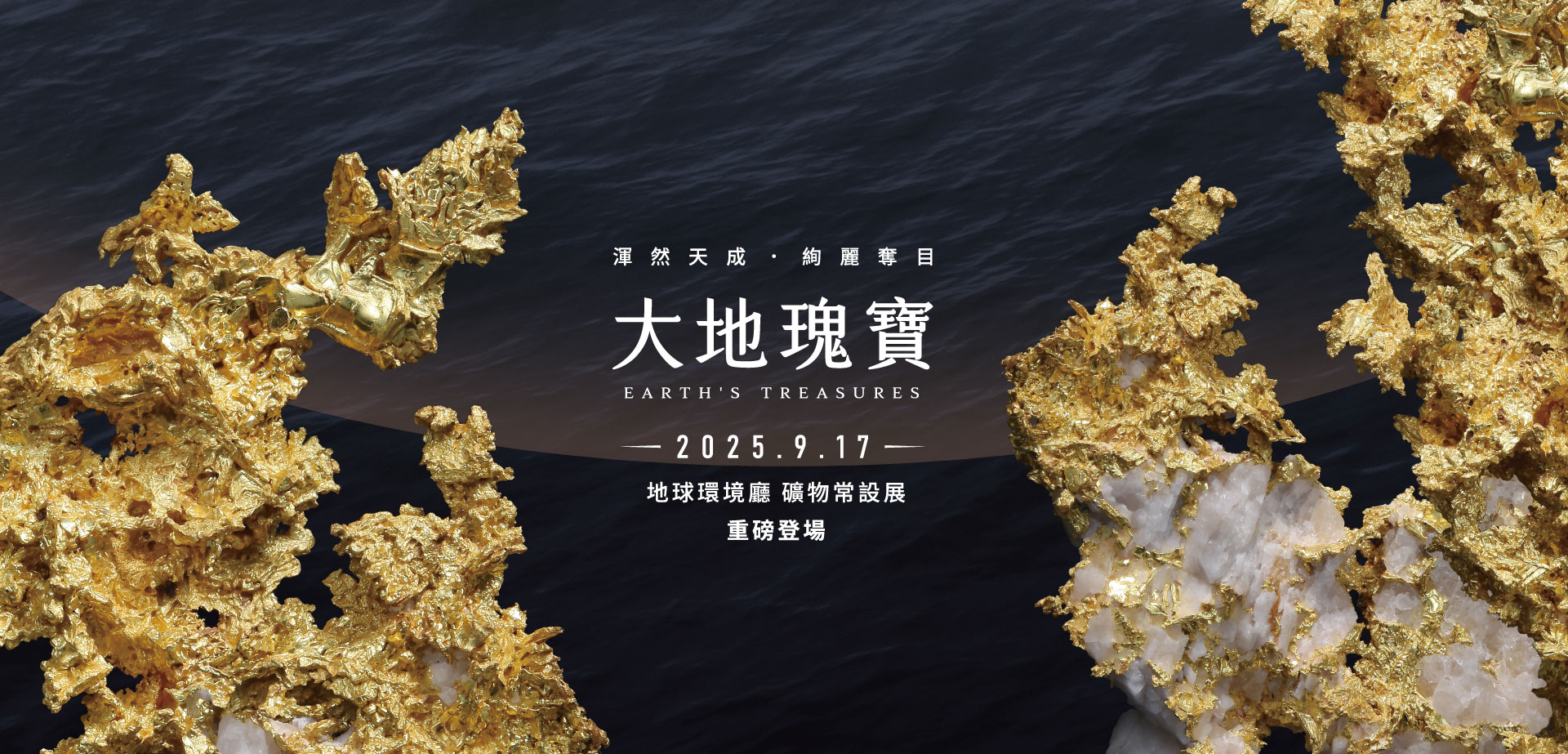
National Museum of Natural Science "Treasures of the Earth" Mineral Permanent Exhibition
After 5 years of planning, the National Museum of Natural Science is now proudly launching Taiwan's first large-scale mineral permanent exhibition, "Treasures of the Earth." The exhibition area is divided into 3 halls, covering nearly 600 ping (approx. 1,980 sq. meters). It brings together the museum's rare mineral collections from over 30 years, featuring more than 1,700 selected mineral specimens on site. These include a massive stalactite group, fluorescent minerals that radiate brilliant colors under different wavelengths of ultraviolet light, a giant heart-shaped amethyst geode, Taiwan's unique treasure Peitou stone (北投石), as well as Chiufen (九份) and Chinkuashih (金瓜石) which once created Taiwan's economic miracle, along with natural gold and Fengtian nephrite (豐田閃玉). There is also the lunar rock brought back by Apollo 11, marking humanity's first successful moon landing. The scale is grand, and each exhibit has a fascinating story, fully presenting the magnificent journey of minerals from their formation on Earth, through environmental changes, to human applications.
"Treasures of the Earth" takes "Exploring Earth's Treasures" as its core concept. The entrance is designed with a cave-like imagery, leading visitors into 8 major units: "Mineral Evolution," "Minerals Are Everywhere," "The Beauty of Crystal Symmetry," "The Beauty of Crystal Color," "Taiwan's Treasures," "World Mineral Regions - A Grand View of Crystals," "The World of Minerals," and "Minerals and Life." Through situational design, multimedia interaction, and innovative displays, visitors will learn about the evolution, characteristics, aesthetic value of minerals, and their close connection with human life.
Planning for "Treasures of the Earth" began in 2019. The geology research team, centered on the museum's collection specimens, planned the visitor flow according to evolutionary processes, the crystal forms and colors of physical properties, growth environments and natural elements, as well as Taiwan's mineral resources and characteristic mineral regions of the world. In the high-ceiling area, the museum's collection of a stalactite forest weighing 5 tons and standing 3 meters tall is erected, which is quite spectacular. It also recreates the original cave landscape of stalactites, allowing an understanding of their growth context. This is one of the highlight exhibits of this exhibition, hoping to guide visitors to gradually delve into the mineral kingdom that combines both knowledge and beauty.
"Treasures of the Earth" takes "Exploring Earth's Treasures" as its core concept. The entrance is designed with a cave-like imagery, leading visitors into 8 major units: "Mineral Evolution," "Minerals Are Everywhere," "The Beauty of Crystal Symmetry," "The Beauty of Crystal Color," "Taiwan's Treasures," "World Mineral Regions - A Grand View of Crystals," "The World of Minerals," and "Minerals and Life." Through situational design, multimedia interaction, and innovative displays, visitors will learn about the evolution, characteristics, aesthetic value of minerals, and their close connection with human life.
Planning for "Treasures of the Earth" began in 2019. The geology research team, centered on the museum's collection specimens, planned the visitor flow according to evolutionary processes, the crystal forms and colors of physical properties, growth environments and natural elements, as well as Taiwan's mineral resources and characteristic mineral regions of the world. In the high-ceiling area, the museum's collection of a stalactite forest weighing 5 tons and standing 3 meters tall is erected, which is quite spectacular. It also recreates the original cave landscape of stalactites, allowing an understanding of their growth context. This is one of the highlight exhibits of this exhibition, hoping to guide visitors to gradually delve into the mineral kingdom that combines both knowledge and beauty.
Event Details
- 2025-09-17 — 國立自然科學博物館 · 憑展示場門票或恐龍卡即可入場
You Might Also Like
Exhibitions JAN 19 — DEC 31 Now On
National Museum of Natural Science "Fantastic Nature" Permanent Exhibition
The National Museum of Natural Science welcomes a magnificent transformation of its Life Science Hall. The new…
Exhibitions JAN 1 — AUG 9 Now On
"24/7::: Repetition and Layering in Creation" Children's Art Education Exhibition
"24/7" (twenty-four-seven), meaning 24 hours a day, 7 days a week, is an idiom in the English-speaking world used to…
Exhibitions JAN 1 — AUG 9 Now On
"Bopomofo Stamps Tour Taiwan" Special Exhibition
Every town and village in Taiwan has its own unique charm. We invite you to follow the colorful Zhuyin Fuhao (phonetic…